
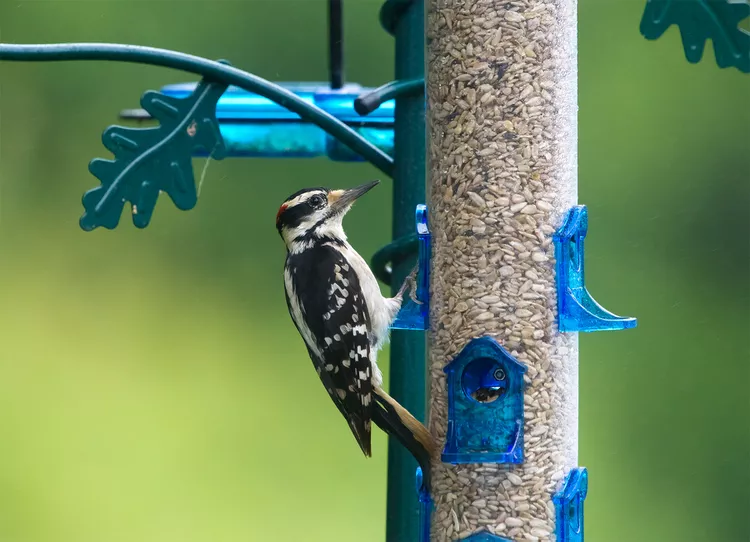
Although beautiful, woodpeckers are often noisy, and they can be destructive—especially if they are pecking away at your house. The damage they do is easy to recognize; most often, you will spot a series of small, deep holes in neat vertical or horizontal rows. Larger holes indicate the woodpecker is trying to create a nesting site, but the dead giveaway is the loud hammering noise they make.
So, how do you stop woodpeckers from pecking your house? Understanding the birds' habits and behaviors can help you deter them from damaging your home.
Why Do Woodpeckers Peck?
Nuisance woodpeckers can be tricky to deter. Understanding why they hammer is the first step in knowing what to do about it. There are four reasons for woodpeckers’ hammering habits:
Attracting Mates
“Drumming is a behavior woodpeckers do to attract mates and repel rivals. It involves pecking just to make sounds,” explains Emma Greig of the Cornell Lab of Ornithology. If this is the case, the pecking usually stops when mating season commences in spring.
Emma Greig is the project leader and manager of Project FeederWatch at the Cornell Lab of Ornithology.
Foraging for Food
“They also make sounds when they are foraging for food because of the pecking,” Greig says. “It all makes noise, unfortunately!” Woodpeckers may be searching for insects in your siding, such as the larvae of carpenter bees, leafcutter bees, or termites. They also feed on wood borers, ants, grubs, and caterpillars. Eliminating insect pests and filling the holes in your siding should discourage the woodpeckers’ hammering on your house if food is their objective, and they will likely begin to look elsewhere.
Building Nests
A woodpecker may be trying to create a nest cavity in the siding of your home. If so, it will be round or irregular and fairly large. This usually occurs in spring at the beginning of their breeding season. If you see such a hole, evict the birds before or after nesting season and cover the hole. Do not trap the birds inside.
Storing Acorns
In the Western and Southwestern states, the acorn woodpecker stores acorns in holes drilled in trees or houses. Each hole is about the size of an acorn.
How to Stop Woodpeckers from Pecking Your House
The most common woodpeckers in North America are the downy, hairy, pileated, acorn, and red-bellied woodpeckers, the yellow-bellied sapsucker, and the northern flicker. Aim your efforts at redirecting their focus away from your house. Don’t use sticky traps that could harm the birds. There are several ways to approach the problem, but you may need to try more than one.
The North American Migratory Bird Act protects woodpeckers. Like other birds, they are an important part of our ecosystem and should not be killed.
1. Eliminate the Insects
If the woodpeckers are feeding on insects that live in your siding, eliminate the insects. You might need to hire an exterminator to get rid of the bugs, which may be doing serious damage to your house on their own. The woodpeckers’ hammering might actually alert you to a problem that needs your attention.
2. Watch for Roosting Cavities
If the birds have made (or are starting to make) a roosting cavity, cover it quickly, but be sure no birds are inside. If they’ve already made a home in your siding, wait until the nesting period is over before covering the hole. Setting up woodpecker nesting boxes in your yard may discourage the birds from using your house for raising their brood.
Because most woodpeckers prefer to excavate their own roosts, fill the nesting box with wood chips and tamp them down a bit. Smaller woodpeckers, such as the downy woodpecker, need a nesting box with a 1 ½ inch diameter hole, while larger woodpeckers, such as the northern flicker and the hairy woodpecker, need a box with a 2 ½ inch hole.
3. Coax the Birds Away
Since woodpeckers are fond of suet, you may be able to coax them away from your house by serving them this alternative meal. Set up your feeder close to the house at first and gradually move it further away. Be sure to keep it filled. They also feed on many berries, so planting trees and shrubs with bird-friendly fruit may help keep them away from your house. Some of their favored fruit sources are chokeberries (Aronia), serviceberries (Amelanchier), dogwood (Cornus), and wild cherry (Prunus).
4. Try a Deterrent
Researchers at the Cornell Lab of Ornithology tested several woodpecker deterrents, including woodpecker distress calls followed by the call of a hawk, full-sized plastic owls with paper wings, reflective streamers, and plastic eyes hung on fishing lines, among others. While most deterrents had some effect, none of them worked all the time. Some, such as the owl and distress calls, were effective initially, but woodpeckers seemed to get used to them after a short time.
The most consistent deterrent was the reflective streamers; look for mylar holographic tape if you plan to try this yourself. Woodpeckers don’t like shiny objects, especially when they move in the wind. Similar shiny objects have also been effective. Mirrors, aluminum foil, and mylar balloons suspended from areas where woodpeckers have been spotted may alarm them sufficiently so they’ll go elsewhere.
5. Hang Bird Netting
If your woodpeckers aren’t intimidated by your scare tactics, you can keep them away from your house by hanging bird netting from the roof line to the ground. Be sure to seal the sides of the netting so they can’t sneak through. Keep the netting at least 3–4 inches away from the siding so the woodpeckers' beaks cannot reach through.