
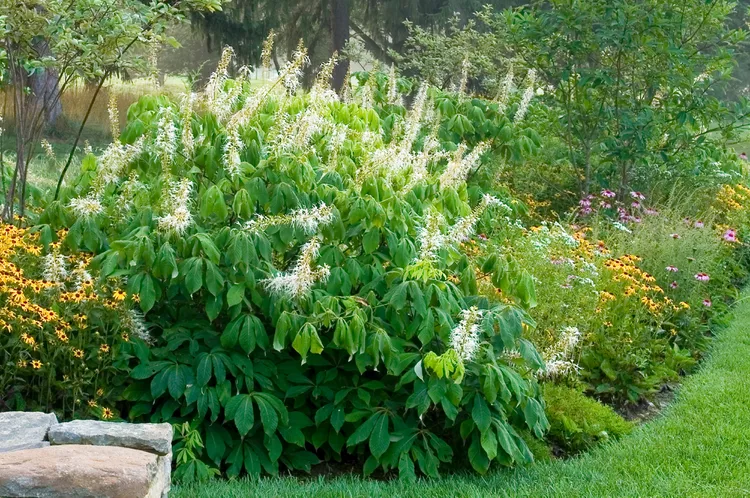
An uncommon plant with long seasonal interest, bottlebrush buckeye (Aesculus parviflora) is a southern U.S. native shrub. It attracts swallowtail butterflies with its wands of white flowers that bloom in summer. It grows up to 12 feet tall, serving as a screen to separate the garden from unwanted views during the growing season.
Bottlebrush buckeye is toxic to humans and pets.
Bottlebrush Buckeye Overview
| Genus Name | Aesculus parviflora |
| Common Name | Bottlebrush Buckeye |
| Plant Type | Shrub |
| Light | Part Sun, Shade |
| Height | 8 to 12 feet |
| Width | 10 to 15 feet |
| Flower Color | White |
| Foliage Color | Blue/Green |
| Season Features | Colorful Fall Foliage |
| Special Features | Low Maintenance |
| Zones | 4, 5, 6, 7, 8 |
| Propagation | Seed, Stem Cuttings |
Where to Plant Bottlebrush Buckeye
Plant bottlebrush buckeye in USDA Hardiness Zones 4-8. Select a location with partial shade and well-drained soil.
Use it as an understory plant in woodland gardens, as a specimen plant, or in a mixed border garden. This plant creates structure in the garden and landscape. Place it on the perimeter of perennial gardens to create a sense of enclosure and emphasize the plants within.
Another way to use this shrub is at the edge of wooded areas or in shady areas of the yard. Place bottlebrush buckeye shrubs in a shade garden, allowing perennials and other shorter plants to grow up to and around them.
How and When to Plant Bottlebrush Buckeye
Bottlebrush buckeye is best planted in spring or fall to avoid hot and dry summer weather in your location. Dig a hole twice as wide and with the same depth as the plant’s nursery container. Set the plant in the hole and backfill with soil removed from the hole. Water it and press down on the soil to remove any air pockets. Add 1 to 3 inches of mulch to the planting area but not touching the stem of the shrub. Provide supplemental water for the first year.
Space shrubs 8 feet apart for a solid border and 18 feet apart for a more spacious landscape design.
Bottlebrush Buckeye Care Tips
Light
Bottlebrush buckeye prefers partial shade and will grow in full shade. In partial shade, it produces more flowers.
Soil and Water
Plant in moist, well-drained soil amended with plenty of organic matter. Bottlebrush buckeye does not have particular pH requirements, it grows in slightly acidic to slightly alkaline soil (pH 5.0 to 8.0).
Apply supplemental water to the new plants the first year, being sure that dry soil receives water. Bottlebrush buckeye is not drought-tolerant. Lack of rain and dry soil causes the shrub to droop and lose leaves. Avoid this situation by regular watering or relocating the plant to a partial shade location.
Temperature and Humidity
Bottlebrush buckeye enjoys warm growing temperatures and moderate-to-high humidity. It grows best in 50 to 80 degrees but tolerates a wider temperature range. However, in temperatures in the low 20s, the shrub suffers cold damage.
Fertilizer
Bottlebrush buckeye isn’t a heavy feeder and fertilization is unnecessary if the soil is amended with ample organic matter at planting time. If not, a monthly application of tree and shrub fertilizer from spring to fall will keep the shrub growing and blooming.
Pruning
Prune the shrub only to remove injured branches to avoid damaging the plant's natural form. Remove spent flower stalks only after flowering. Bottlebrush buckeye flowers on old wood, so prune soon after flowering before new buds form.
Pests and Problems
Bottlebrush buckeye is relatively disease resistant, but it is susceptible to powdery mildew, leaf spot, and rust. Planting the shrubs in full sun and well-draining soil limits these diseases. It attracts Japanese beetles.
How to Propagate Bottlebrush Buckeye
Propagate this shrub by collecting seeds or taking softwood cuttings.
Seeds: Seeds should be gathered as soon as the seed pods drop to the ground. Don’t wait for them to dry out; dried seeds are less likely to be viable. Place the seeds in a brown paper bag in a warm, dry place for a couple of days, but plan to sow the seeds within a week of collecting them.
Sow the seeds in a 1-gallon nursery pot filled with seed-starting mix or potting soil. Space the seeds 2–3 inches apart and cover them with 1–2 inches of planting medium. Water immediately. Put the pot in a sheltered area where you can monitor it over the winter. The seeds will germinate in full sun in the spring, Transplant the seedling into the landscape when it has gained size and a robust root system.
Cuttings: Take 12-inch softwood stem cuttings in early summer. Remove all foliage except the very top and dip the cutting into rooting powder. Insert the cutting into potting soil, water well, and cover with a clear plastic bag. Check regularly to see that the soil remains moist, and mist the cutting every couple of days until new growth appears.
Types of Bottlebrush Buckeye
In addition to the species shrub, there is one cultivar of bottlebrush buckeye. Other plants share the common name bottlebrush but they belong to the Callistemon genus, which is botanically not related and in a different plant family than Aesculus.
‘Rogers’
Rogers bottlebrush buckeye (Aesculus parviflora var. serotina ‘Rogers’) differs from the straight species by growing larger—up to 20 feet—and flowering three weeks later. Another difference is the length of the panicles, 18 to 30 inches as opposed to the 12 inches on the species.
Bottlebrush Buckeye Companion Plants
Solomon’s Seal
Solomon’s seal thrives in moist, rich, well-drained soil and shady areas, often under trees—think of woodland or shade gardens. Cool, humid, and shady locations are best. It grows to 6 feet tall and has green foliage that turns golden in autumn. Zone 3-9
Bleeding Heart
Bleeding Heart (Dicentra spp.) is a classic cottage garden staple that grows in shade or part sun and is quick to pop up in spring. These small plants grow to only 12 inches tall and hold their pink or white blooms above the foliage for a cheerful show. Zone 3-9
Hosta
The many varieties of hostas (Hosta spp.) are perfect additions to shade garden settings. They come in all sizes, and some varieties have showy, fragrant flowers, but these plants are known primarily for their spectacular foliage. Zone 3-9