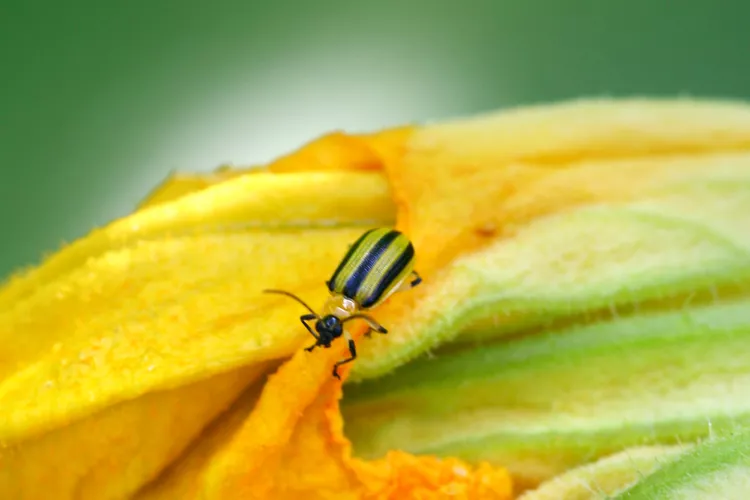
If you happen to spot some small striped or spotted beetles crawling on your cucumber plants, you are probably looking at cucumber beetles. They may also show up on your squash, pumpkins, and melons because these insects will eat any member of the cucurbit family. The pests feed on leaves and reduce yield, but the bigger problem they cause is spreading a wilt disease that kills plants. A few easy prevention techniques can help you avoid or reduce an infestation, but you'll need to act early. Here's how to get rid of cucumber beetles on your plants and minimize their damage.
What are cucumber beetles?
There are two distinct species of cucumber beetles—striped and spotted. Both types are yellow and black and are about ¼ inch long. The abdomen of the striped cucumber beetle is—you guessed it—striped yellow and black. Its spotted cousin has a yellow abdomen with 12 black spots.
Immature beetles, or larvae, are whitish, about ⅜ inch long, and live in the soil. "The larvae will feed on cucurbit roots, but are rarely detrimental to the plant or yield," says Jerry Brust, IPM Vegetable Specialist for the University of Maryland Cooperative Extension Service.
The adult beetles overwinter in leaf litter or other plant debris. "A key difference between the two species is that the striped cucumber beetle can overwinter in the Midwest, while the spotted cucumber beetle cannot, and it must travel northwards each year. In the Midwest, we usually don't have significant issues with the spotted cucumber beetles due to their later arrival," explains Patrick Liesch, director of the University of Wisconsin, Madison Insect Diagnostic Lab.
What do cucumber beetles eat?
Beetles most often feed on leaves and can defoliate young plants. This is when plants are most susceptible. The insects mostly feed from the underside of leaves, leaving holes and discoloration in their wake. The beetles will move to stems, flowers, and fruit if populations are high.
The most serious problem caused by striped cucumber beetles is the spread of bacterial wilt disease from infected cucurbits or weeds. Once infected, a plant cannot be saved—it wilts, leaves dry up, and stem by stem the plant dies. Remove infected cucumber plants to help prevent further spread of the disease. Make sure to dispose of the plants in the trash, not your compost bin to avoid any further spread of the disease. Cucumbers and muskmelons are more susceptible to bacterial wilt than other cucurbits.
How to Avoid Cucumber Beetles
There are several strategies you can use to avoid an infestation of cucumber beetles. "One important approach is to choose varieties that are less attractive to beetles. That can help prevent issues before they even begin. Crop rotation and using trap crops can also help," says Liesch, who is also known as the Wisconsin Bug Guy.
A trap crop is a plant you grow specifically to attract the pest, to keep it from harming your desired crop. "You can plant a highly preferred cucurbit like Blue Hubbard squash that the beetles will preferentially feed upon before you plant your main crop of cucurbit. This early population of striped cucumber beetles is the most devastating one and the longer you can keep them off of your main crop the better. Much of the Blue Hubbard squash will be damaged but that is its purpose," explains Brust. "The trap crop works some of the time but not always as beetles will find the main crop and feed and infect that too eventually," he adds.
Row covers are a great way to prevent an infestation. "Growers should use row covers and cover their main crop of cucurbits until the plants begin to flower and then remove the row cover. By this time plants are big enough to take most beetle feeding without a problem and beetle populations have decreased from earlier in the season," says Brust.
Other preventive strategies include removing weeds that can serve as alternate hosts; mulching around plants to discourage egg laying; removing the remains of old plants at the end of the season to reduce overwintering sites for adult beetles; and rotating your cucurbit crops to avoid planting them near overwintering beetles.
How to Get Rid of Cucumber Beetles
"It is very difficult to stop an infestation after it starts. Once beetles find and begin to feed on cucurbits they release an aggregation pheromone along with plant volatiles and then other striped cucumber beetles will come to this party in high numbers," says Brust.
If you do find beetles on your plants, you have several options to reduce their populations. You should monitor your plants frequently—at least every couple days. "Beetles can be crushed by hand or knocked into a container of soapy water, although they are pretty agile," suggests Liesch. You may find it easier to pick them off if you wear gloves coated with petroleum jelly. You can also use yellow sticky traps to capture them.
Insecticides such as neem oil and pyrethrin will help reduce severe infestations, although pyrethrin is only effective when it comes in contact with the beetles—it has no residual. There are several natural predators that feed on cucumber beetles including ladybugs, braconid wasps, and green lacewings. Avoid spraying if you see predators in action.