How to Prune Thyme to Keep Your Herb More Productive

9.3K
555
227
2025-11-10
How to Prune Thyme to Keep Your Herb More Productive

If you have just one thyme plant in a container, you may be harvesting enough to encourage plenty of fresh new growth–use it in garlic-thyme sauce or thyme-roasted chicken. But knowing how to prune thyme can help when your plant starts getting leggy or straggly. Keeping culinary thyme, and even creeping thyme varieties used as groundcover, in a neater shape will result in more fresh, tender growth and fewer bare, woody stems.

Reasons for Pruning Thyme

Prune culinary thyme when you want the plant to produce more vegetative growth with a bushy habit. Occasional pruning will help keep it from getting woody and sparse at the base. Gardeners also prune thyme to remove flowers so the plant remains in the growth stage (rather than reproductive), and for taking cuttings to propagate more thyme.

Encourage a bushy shape.

Thyme plants, even upright varieties, tend to be a bit sprawling and can look loose and carefree. But, that informal look often comes with straggly branching. Trimming the runaway stems will cause them to be bushy and vigorous. Older plants tend to get sparse and shrub-like at the base (and unattractive). A refresh in spring will help stems tender and pliable instead of woody.

When a stem is trimmed, the plant responds by sending out more branches from the nearest node. Thyme is a semi-woody herb, and pruning has the same effect as it would on woody shrubs like yew (Taxus spp.) or boxwood (Buxus spp.)–it forces more branching and a compact habit with more foliage.

Prevent thyme from flowering.

Thyme flowers are edible, and pollinators love them, but many gardeners prefer to keep their thyme in vegetative mode so that the plants continue making more tasty leaves. Thyme doesn't acquire a bitter taste after flowering like some other herbs. However, it can taste slightly mild, with a less potent flavor and aroma. 

Once you've harvested all the thyme you'll want for the year, you may wish to let it flower and enjoy watching the bees go crazy for it. Thyme flowers are dainty and attractive, lending themselves well to homegrown bouquets of cut flowers.

Cuttings for thyme new plants.

Straight growing stems of this year's growth are excellent candidates for propagating with stem cuttings you can use to create more thyme plants. Here's how:

  1. Snip off a section containing a growing tip and about 4-6 inches of stem. Select a stem that is not flowering or hasn’t flowered yet.
  2. Do a final trim on the cutting just below a node, and gently strip the leaves off the bottom ⅔ of the stem. 
  3. Gently poke it into moist potting soil (add a big handful of perlite or use seed-starting mix to boost drainage), and keep it moist by covering or misting regularly. 
  4. Set them out of direct sunlight. In about 3-4 weeks, your thyme cuttings should be rooted. 

When to Prune Thyme Plants

Thyme can be pruned or cut back several times yearly for mass harvesting or to control flowering, shaping, and gathering stem cuttings. Autumn is a good time for a general haircut pruning. Lighter pruning can be done at any time.

If you are pruning a small plant or only a few stems, take the extra moment to do it via the method below. If you have many plants or a large plant, it's okay to grab a handful and cut all at once, even if it isn't exactly at a node.

Steps for Pruning Thyme

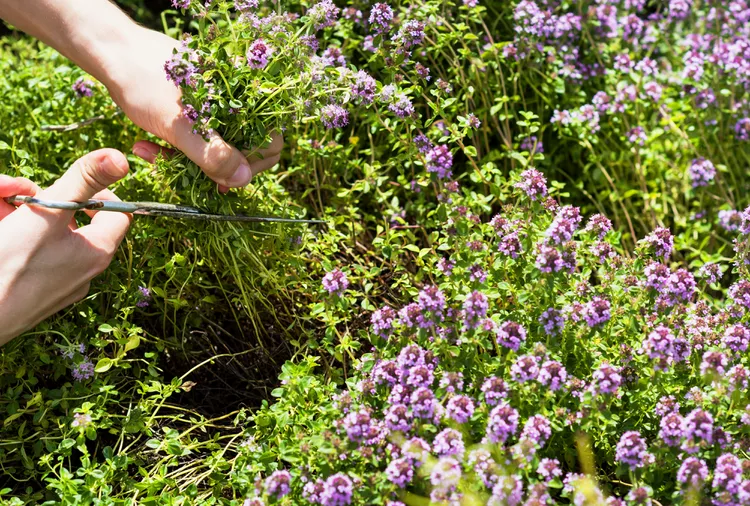
Pruning thyme plants is a snap; it might be the most pleasant-smelling task you've ever done.

  1. Grab a stem and look for a node where leaves attach to the stem. There's usually a node on culinary thyme about every inch or so.
  2. Use your fingernails, herb snips, or scissors to pinch or snip the stems just above the node.
  3. Repeat for any stems that are flowering or to force more growth. Avoid removing more than ⅓ of the stem at a time or ⅓ of the entire plant at the same pruning.

If you're going to propagate some of the pruned thyme stems, keep them from drying out by immediately placing them in a sealed plastic bag with a damp paper towel until you can get them back to the house and potted up. 

Care Tips for Thyme Plants

Pruning and frequent harvesting will keep your thyme in good shape, and providing it with the right amounts of water and light will help it produce the most flavorful leaves full of aromatic oils.

Watering

Once established, thyme is drought tolerant. In fact, this herb would rather grow on the dry side and suffers in consistently moist conditions. When growing in the ground, it seldom needs to be watered unless you are experiencing extremely dry weather.

Thyme grown in containers likely will need supplemental watering in between rain showers. Let the soil dry out a bit first. Test by sticking your finger in the potting soil and feeling for moisture. Wait to water until it feels dry up to the middle knuckle. Watering thoroughly but infrequently is better than many constant shallow waterings to encourage deeper roots.

Light

Thyme grows best in full sun. It loves dry, warm, sunny weather (like the Mediterranean) and will grow slowly and have less flavor in lower light. Thyme can be grown quite successfully indoors, but you'll need to provide a super-sunny window or bright artificial light to make it happy.

Related Article

3 Potted Plant Arrangement Ideas for a Gorgeous Patio Garden
9.1K
273
27

3 Potted Plant Arrangement Ideas for a Gorgeous Patio Garden

Fill a space with beautiful color and texture using containers that rival earthbound flower beds—especially in spots where planting is difficult.
6 Must-Know Tips on Mandevilla Care in Pots to Keep the Flowers Coming All Summer
15.4K
1.1K
496

6 Must-Know Tips on Mandevilla Care in Pots to Keep the Flowers Coming All Summer

Mandevilla care in pots is a little different than growing these gorgeous summer-blooming plants in the ground. Use these tips to keep your potted mandevilla plant thriving and flowering all season.
14 Holiday Planter Ideas That Will Give Guests a Warm Welcome
15.8K
946
132

14 Holiday Planter Ideas That Will Give Guests a Warm Welcome

Use outdoor arrangements to set a festive mood this holiday season. Copy these holiday planter ideas, or use them as inspiration for your custom look.
7 Easy-to-Grow Bonsai Tree Types Perfect for Beginners
11.9K
830
141

7 Easy-to-Grow Bonsai Tree Types Perfect for Beginners

These bonsai tree types are easy to care for, indoors and outside. They include tough conifers such as juniper and pine, and popular houseplants such as ficus and schefflera.
How to Plant and Grow a Redbud Tree
29.4K
1.5K
161

How to Plant and Grow a Redbud Tree

Add colorful texture and three seasons of interest to small garden spaces with the easy-to-grow redbud tree.
How to Sharpen Your Lawn Mower Blade for a Cleaner Cut
39.1K
1.6K
750

How to Sharpen Your Lawn Mower Blade for a Cleaner Cut

Follow this step-by-step guide on how to sharpen your lawnmower blade for grass that will look tidier and stay healthier all season long.
How to Get Rid of Clover in Lawns
21.6K
864
224

How to Get Rid of Clover in Lawns

Learn how to get rid of clover in lawns with these tips for using fertilizer, herbicides, and more, plus advice for embracing a mixed-species lawn.
How to Grow and Maintain a Zoysiagrass Lawn
26.2K
262
36

How to Grow and Maintain a Zoysiagrass Lawn

Slow-growing zoysiagrass is a lawn grass for warm climates. Count on it to grow well in part shade or full sun and stand up to foot traffic.
How to Plant Sod in 5 Simple Steps
42.7K
854
409

How to Plant Sod in 5 Simple Steps

Sod is best planted in the spring and early autumn when the temperatures are cooler. Follow these steps for a how to plant sod.
25 Gardening Tips Every Gardener Should Know
16.7K
667
120

25 Gardening Tips Every Gardener Should Know

Whether you have a green thumb or not, check out this list of essential gardening tips to ensure that all your plants grow and thrive.
How to Propagate a Rubber Plant Successfully
1.8K
176
66

How to Propagate a Rubber Plant Successfully

Learn how to propagate rubber plants through cuttings and air layering with this step-by-step guide.
Here's Why Your Snake Plant Leaves Are Falling Over, and What to Do About It
33.1K
3.3K
1.1K

Here's Why Your Snake Plant Leaves Are Falling Over, and What to Do About It

Wondering why your snake plant leaves are falling over? This guide will help you figure out and fix the problem.
How to Grow and Care for a Coffee Plant Indoors
46.1K
922
405

How to Grow and Care for a Coffee Plant Indoors

Learn how to grow a coffee plant indoors, including tips on light, humidity, watering, and pot size. This houseplant will add a tropical touch to your home with its glossy green leaves.
How to Plant and Grow Vanilla Bean Orchids
29.3K
1.2K
257

How to Plant and Grow Vanilla Bean Orchids

Some orchids do more than flower. Find out how to grow vanilla bean orchids at home and harvest your own vanilla beans.
11 Tropical Flower Plants That Will Enliven Any Room
12.5K
625
250

11 Tropical Flower Plants That Will Enliven Any Room

Add color to your home with these blooming tropical flower plants. We have all the info you need to care for them to add color and fragrance.
How to Spot 5 Common Plant Diseases and Keep Your Garden Healthy
4.4K
219
37

How to Spot 5 Common Plant Diseases and Keep Your Garden Healthy

Protect your plants from the most common diseases. Learn to recognize the symptoms and how to prevent these diseases in the first place.
8 Insect-Repelling Plants that Work Naturally to Send Bugs Packing
34.4K
2.8K
660

8 Insect-Repelling Plants that Work Naturally to Send Bugs Packing

Improve your time outdoors with a few strongly scented insect-repelling plants, which can send pesky biting bugs, like mosquitoes and flies, packing.
Prevent Damping Off Disease in Seedlings with These 8 Simple Tips
25K
1.5K
210

Prevent Damping Off Disease in Seedlings with These 8 Simple Tips

Protect seedlings from damping off disease and boost seed germination rates with these growing tips.
How to Get Rid of Cucumber Beetles on Your Plants
40.6K
405
52

How to Get Rid of Cucumber Beetles on Your Plants

Have you noticed little bugs on cucumber plants in your garden? Find out how to identify a cucumber beetle and prevent these insects from killing your cucumber, melon, squash, and other crops.
21 Best Vegetables to Grow in Pots
4.1K
326
68

21 Best Vegetables to Grow in Pots

Choose from these vegetables to grow in pots to enjoy plenty of homegrown produce even from a small space. From petite tomato plants to mini melons, this list includes 21 tasty options that will thrive in containers.