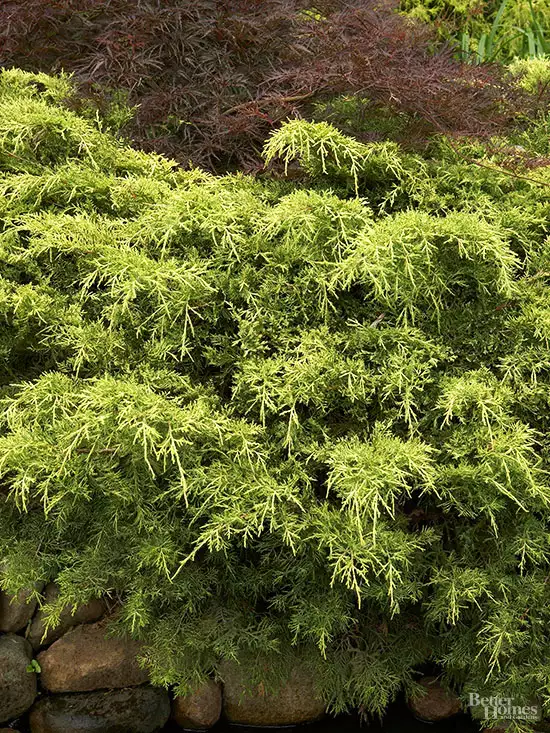
The Saybrook Gold juniper is a low-growing, spreading evergreen shrub valued for its striking foliage color year-round. During the warm season, the soft, feathery foliage is golden-yellow and in the winter, it becomes an attractive bronze-yellow. As the plant matures, the arching branches and gracefully drooping stem tips hug the ground.
This hybrid is one of the Chinese junipers with the brightest foliage—and thankfully one that deer don’t browse. Other bonus points are the shrub’s fast growth rate, compact size, and tolerance of air pollution.
Saybrook Gold Juniper Overview
| Genus Name | Juniperus chinensis 'Saybrook Gold' |
| Common Name | Saybrook Gold Juniper |
| Plant Type | Shrub |
| Light | Sun |
| Height | 3 to 4 feet |
| Width | 5 to 6 feet |
| Foliage Color | Chartreuse/Gold |
| Season Features | Winter Interest |
| Zones | 4, 5, 6, 7, 8, 9 |
| Propagation | Stem Cuttings |
| Problem Solvers | Deer Resistant, Drought Tolerant |
Where to Plant Saybrook Gold Juniper
Saybrook Gold Juniper needs a location in full sun. It grows in a range of soils including clay and dry soil and it's not particular about soil pH. However, excellent drainage is crucial.
The plant is tolerant of air pollution, which makes it suitable for urban settings.
Plant a specimen as a colorful accent in a foundation planting or plant several shrubs in a group or as a low hedge. Mass plantings on embankments and slopes help with erosion control. Because it is tolerant of dry soil, it is also a good choice for rock gardens and xeriscapes.
How and When to Plant Saybrook Gold Juniper
Nursery-grown junipers in containers can be planted any time of the year, although planting in the spring before the hot summer weather sets in is preferable. Balled-and-burlapped shrubs should be planted in the fall.
Dig a hole at least twice the diameter of the root ball and just as deep. Place the shrub in the hole and backfill with the original soil so that the top of the root ball is flush with the soil. Tamp down the soil. Water it well and continue to water it regularly during the first growing season in the absence of rain to encourage a strong root system.
For a solid hedge, space plants 4.5 to 5 feet apart. If you would like the shrubs to eventually grow into each other, space them 6 feet apart. For all other plantings, space them 10 to 12 feet apart.
Saybrook Gold Juniper Care Tips
Saybrook Gold is a popular landscape plant for good reasons—it is easy to grow and requires little maintenance.
Light
Although Saybrook Gold juniper also grows in partial shade, it is only in full sun that its golden-yellow foliage displays its best color.
Soil and Water
In terms of soil and pH, Saybrook Gold juniper is adaptable and even grows in clay soil as long as there is good drainage. Water-logged soil is not suitable. The pH can be between slightly acidic and neutral (5.5 to 7).
Watering is usually only required for the first season, or until the plant is established; afterward, it is considered drought-tolerant.
Temperature and Humidity
This is a winter-hardy shrub that survives temperatures as low as minus 30 degrees F. The plant does not have any particular humidity requirements.
Fertilizer
Saybrook Gold Juniper is a light feeder. One annual application of a slow-release shrub and tree fertilizer in late winter or early spring is sufficient. Never fertilize later than two months before the first frost date in your area, as new tender growth late in the season is especially susceptible to cold injury.
Pruning
Pruning of this compact shrub is rarely required; it is done between early spring and early summer to maintain the size and remove any wayward branches. Broken or diseased branches, on the other hand, should be removed promptly at any time of the year.
Potting and Repotting Saybrook Juniper
Due to its size, Saybrook Gold juniper is not a good choice for containers. If you would like a shrub with similar all-season interest, dwarf golden arborvitae (Thuja occidentalis) 'Golden Child' is much better suited for potting.
Pests and Problems
Saybrook Gold Juniper is not affected by serious pests or diseases. Most importantly, it is resistant to cedar apple rust, a fungus that affects other junipers. It is susceptible to tip and needle blights. It is deer-resistant.
How to Propagate Saybrook Juniper
Saybrook Gold junipers are propagated from stem cuttings. Between mid-autumn and mid-winter take a 6-inch cutting. Dip the cut end in rooting hormone and insert the cutting about halfway into pots filled with damp potting mix. Cover the container with a plastic dome (an inverted bottle with the top part removed also works well) because the cutting needs relative high humidity to root. Keep the cutting indoors in a location with bright light but away from direct sunlight. Water when the soil feels dry. The cutting has rooted when you gently tug on it and it doesn’t wiggle.Let the cutting grow in the pot for about a year, then transplant it to your yard or a larger pot.
Saybrook Juniper Companion Plants
'Fat Albert' Colorado Blue Spruce
The rich blue needles of this pyramidal conifer contrast beautifully with the golden-yellow foliage of the Saybrook Gold juniper. It is a very slow grower but grows 10 to 15 feet tall and 20 feet wide over time. Zone 2-8
Ozark Witch Hazel
Hamamelis vernalis, also known as vernal witch hazel, is native to North America. It grows in full sun and partial shade but flowers best in full sun. Zone 3-8
'Icee Blue' Juniper
Juniperus horizontalis 'Icee Blue' is a fast-growing groundcover with a height of only 4 inches and spreading up to 8 feet. It is evergreen but its foliage darkens to a plum-purple color in cold climates. Zone 3-9
Garden Plans for Saybrook Juniper
Property Line Garden Plan
With this garden plan. the plantings along your property become as attractive as the rest of your landscape From summer into fall, you'll enjoy blossoms in soft shades of violet-blue and yellow, thanks to perennials like catmint, coreopsis, and yarrow, while the silver-blue and bright chartreuse-gold foliage of evergreen blue spruce and juniper draw the eye upward. Mingle in the plan's optional bulbs (crocus, daffodils, and tulips) for a little early spring color.